TSG’s Key Takeaways from the 2026 Federal Planning Workshop

In June, The Schreifer Group joined federal planners, agency representatives, industry partners, and friends in Washington, DC, for the 2026 Federal Planning Workshop. Held June 16-18 at the National Press Club, the workshop marked a new partnership between the American Planning Association’s (APA) Federal Planning Division (FPD) and the Society of American Military Engineers (SAME) DC Post.
TSG was pleased to be a sponsor of the event, which offered a combination of high-quality learning, teaching, celebrating, and reconnecting opportunities. We attended excellent sessions, contributed to several conversations from the podium, shared an early preview of what is next for TSG, and ended the week with an unforgettable afternoon on the Potomac.
Key Themes from the 2026 Federal Planning Workshop
The workshop brought together government leaders, planners, architects, engineers, and other professionals to discuss how technology, partnerships, evolving agency priorities, and practical problem-solving are transforming federal project delivery.
Although the sessions covered a wide range of topics, several themes consistently rose to the surface.
Collaboration Is Essential to Federal Planning
Federal planning has always required coordination, but today’s challenges make collaboration more important than ever. Projects frequently cross organizational, disciplinary, geographic, and even national boundaries.
Throughout the workshop, presenters demonstrated how planners can break down silos, engage the right voices early, and build partnerships that produce better and more implementable solutions. Whether the discussion focused on installation resilience, interagency coordination, new mission beddowns, or cross-cultural planning, the message was clear: strong plans are built from strong relationships.
Jennifer Howland and Matt Wilson joined Beth Rothman of AFCEC for “Running Circles Around District Planning: Integrating Explosives Safety Early for Better Outcomes.” Their session demonstrated how early coordination between planners and explosives safety professionals can streamline reviews, prevent conflicts, and reduce the potential for costly redesign later in the planning process.
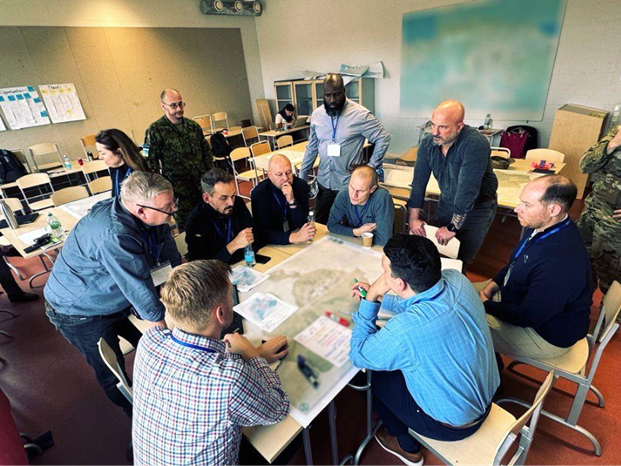
On the second day, Jill Schreifer, Abbey Ness, and Mary Finnegan led “Making Things Easier: Facilitation Tips and Tricks,” sharing practical strategies for engaging participants, navigating challenging group dynamics, and leading more productive planning conversations. Andrea Hancock of Parsons joined the session as a graphic facilitator, translating the discussion and audience contributions into a visual summary in real time. Her illustrations captured the session’s key takeaways while demonstrating how visual storytelling can make complex conversations more engaging, memorable, and accessible.
Overall, this was an immersive session demonstrating how visual tools and collaborative exercises can help project teams establish trust, clarify expectations, and develop a shared vision at the beginning of an effort.


Later that morning, Abbey and Jill joined Alex Bishop of WSP and Ben Keller of Black & Veatch for “The Cross-Cultural Planning Toolkit.” The session explored participatory approaches for planners working with host nations and international partners—an increasingly important capability of federal planning teams working around the world.
Planning Must Lead to Action
Another major theme was the need to connect long-range planning with programming, acquisition, design, and implementation. A plan is most valuable when it gives decision-makers a realistic path forward.
Sessions explored how planners can develop stronger facility requirements, address infrastructure risks, respond to changing missions, and produce recommendations that remain useful as funding, policy, and operational needs evolve. The emphasis was not simply on creating more information, but on making that information understandable, defensible, and actionable.

Technology Should Make Complex Decisions Easier
From artificial intelligence-assisted GIS workflows and digital planning repositories to dashboards, scenario modeling, and data visualization, technology was central to many workshop conversations.
The strongest examples did not treat technology as the final product. Instead, they demonstrated how digital tools can help planners organize complicated information, test alternatives, communicate tradeoffs, and support more informed decisions.
That people-centered use of technology strongly resonated with our team. The best planning tools enhance professional judgment and stakeholder engagement by helping people see challenges more clearly and work toward a solution together.
Throughout the workshop, Matt, one of TSG’s explosives safety planners, provided demonstrations of Siter and shared his technical expertise with conference attendees. The demonstrations highlighted how the software can help planners visualize explosives safety considerations, identify potential constraints, and incorporate technical requirements earlier in the planning process. Attendees also had the opportunity to ask questions and see how Siter supports clearer communication and stronger coordination between planners, explosives safety professionals, and project stakeholders.
The Future of the Profession Depends on People
The workshop also emphasized professional development and the changing role of the federal planner. Today’s planners are expected to understand policy, infrastructure, facilitation, data, visualization, communication, resilience, and implementation—often all within the same project.
Sessions focused on upskilling current professionals while also creating clearer pathways for students and emerging planners to enter the federal planning field. Investing in people, sharing knowledge, and creating opportunities for the next generation will be critical to maintaining a strong federal planning community.
Mary Finnegan and Ricqui Brager (of USACE), representing the Emerging Federal Planners Group (EFP), joined Dr. Paula Loomis (of The Urban Collaborative) for “From Campus to Career: Introducing Attendees to Federal Master Planning.” Through activities and discussion, the session encouraged attendees to support emerging planners and strengthen outreach to university planning programs. The presenters also demonstrated a mini workshop that professionals can use to introduce students to federal master planning and its career opportunities.

Celebrating Bailey
One of the most meaningful moments of the workshop was celebrating our own Bailey Moro and his recognition by FPD for his contributions as an emerging federal planner. Bailey received this year’s FPD’s Outstanding Emerging Planner Award, recognizing his contributions to the federal planning profession.
Bailey brings creativity, curiosity, and a people-focused design perspective to his work. His contributions to and passion for federal installation planning, urban design, visualization, and transportation planning strengthen both our projects and our team.
We were thrilled to celebrate this well-deserved recognition together—and even happier that so many of our friends and colleagues were there to share the moment with us.

Beyond the Conference Room: TSG Team
Taking Federal Planning to the Water
After two full days of sessions, conversations, and activities, the workshop continued beyond the conference rooms.
TSG was proud to serve as a Gold Sponsor and sponsor of the Architectural River Cruise on the Potomac. The two-hour tour gave attendees a different perspective on Washington’s waterfront, infrastructure, architecture, monuments, and development while creating plenty of time for relaxed conversation and networking.
The cruise was an amazing way to close out the experience. We enjoyed beautiful views, great conversations, and time on the water with friends and partners from across the federal planning community.
It was also a fitting conclusion to the workshop. After spending several days discussing how places are planned, experienced, connected, and transformed, we had the opportunity to view our nation’s capital from an entirely different perspective.

Continuing the Conversation at the TSG Planning Retreat
Following the workshop, members of TSG’s planning team stayed in Washington, DC, for a team retreat focused on learning, reflection, and connection. The group discussed takeaways from a shared book review, participated in strengths-based training, and spent time considering how individual talents can support stronger collaboration across the team.
After several busy days of conference sessions, the retreat provided a valuable opportunity to slow down, exchange ideas, and carry the workshop’s themes of communication and collaboration into our own work.

Looking Ahead
The 2026 Federal Planning Workshop reminded us that federal planning is at its best when people openly exchange ideas, share knowledge, build relationships, and make space for the next generation of professionals.
We returned from Washington DC energized by the sessions we attended, proud of the TSG team members who presented, excited for Bailey’s recognition, and grateful for everyone who joined us on the river.
Thank you to APA FPD, SAME DC Post, the speakers, sponsors, volunteers, and attendees who made the workshop such a memorable experience. Visit the Federal Planning Workshop website to learn more about the event and read the session abstracts.
Interested in how TSG brings federal planning, facilitation, visualization, and technical expertise together? Explore our services or contact our team to start a conversation.



Comments